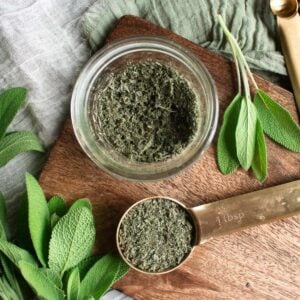
How to Dry Sage
Sage is a popular and wonderfully fragrant herb that grows well in many climates. If you have an abundance of fresh sage on hand, learn these 3 easy methods to dry sage so you can add it to your favorite soups, stews, roasted veggies, and more all winter long
Equipment
- Food dehydrator
- Sheet pan
- Parchment paper
- storage jar
Ingredients
- fresh sage as much as you can gather
Instructions
Oven Method
- Oven drying is the easiest way to preserve your sage harvest and is done very quickly, although the flavor won't be quite as potent as air-dried herbs.
- Remove the stems from the leaves and arrange them in a single layer on a baking sheet lined with parchment paper.
- Preheat the oven to the lowest temperature setting (usually 170 F).
- Place the sheet pan in the oven and crack the door open 6-8 inches.
- Let the sage leaves dry for 20-45 minutes, rotating the leaves halfway through. Continue drying if needed but mine is usually takes about 30 minutes.
- Crush the dried leaves and store in an airtight container.
Dehydrator Method
- Arrange the sage leaves in an even layer on your dehydrator trays and dry at 105 F for 1-3 hours. Rotate the leaves partway through the drying time. Continue dehydrating until fully dried, and the leaves crumble.
- Remove the leaves from the dehydrator, crush, and store in a jar.
Air Drying Method
- Make small bundles of fresh sage and secure each one with a rubber band, then hang it with kitchen twine in a cool, dry place out of direct sunlight for several weeks or until it is fully dried. It's best to select a location with good air circulation to avoid molding.
- Check the sage bundles every few days and bring them down once fully dried. Crush, store, and use as desired.
- Tip: To avoid having pieces of dried sage fall to the floor, you can also place the bundles in a paper bag instead of hanging them on the wall.